A crm for real estate shouldn’t feel like another inbox you have to babysit.
Slow lead follow-up, messy contact lists, and unclear pipelines mean missed opportunities and wasted hours.
The right real estate CRM centralizes client data, automates follow-ups, integrates listings, and helps you move deals through a visual pipeline.
This guide compares the top 10 crm options for agents, teams, and investors (from lightweight free tools to full-featured platforms).
You’ll learn which platforms excel at lead management, IDX integration, marketing automation, and which offer the best value for different budgets.
What is a CRM for real estate
A crm for real estate centralizes client data, automates follow-up, and speeds closings.
A real estate CRM is software that ties leads, contacts, properties, and transactions into one workspace. It stores contact details, call notes, showing schedules, offers, contracts, and property records for easy access.
Automated workflows run email drips, text campaigns, task reminders, and lead routing so you reply faster. A solid platform centralizes client data, automates follow-up, and tracks transaction progress across your team and tools.
Agents who use real estate CRM software win more listings by staying responsive and organized. You gain clearer real estate lead management, better contact organization, improved pipeline visibility, and simpler transaction coordination.
We recommend testing a CRM with IDX CRM integration and real estate marketing automation during a 14–30 day trial. Start by tracking five leads for 30 days, measure response time and conversion, then expand automations that save hours per week.
Key features to look for in a real estate CRM
Real estate lead management and speed-to-lead
Quick routing wins deals: instant capture and fast follow-up boost contact and conversion rates.
We push sub-minute lead routing and SMS-priority follow-up to every test funnel. Here’s what matters:
-
Capture: APIs and webhooks pull leads instantly from Zillow, realtor.com, and IDX feeds.
-
Prioritize: automated scoring highlights high-intent leads by source, search behavior, and budget.
-
Route: rules send SMS, ring groups, and push alerts to the right agent immediately.
Strong real estate lead management prevents lead leakage by automating tasks and reminders. Routing within 60 seconds multiplies contact rates and appointment bookings in our tests.
Turn on instant webhooks, set a 60-second routing SLA, and track response-to-contact metrics daily.
Contact management and relationship tracking
Centralizing client profiles and tracking every touchpoint makes follow-up consistent.
Good real estate CRM platforms store contact data, notes, documents, and property preferences. Look for:
-
Contact management tools that sync email and phone logs
-
Timestamped communication history and last-contact date
-
Automated reminders and follow-up tasks with custom schedules
-
Relationship tracking features like lifecycle tags and client scoring
Consistent, timely follow-up increases closings and referral volume. Pick a CRM that links listings to contacts and shows pipeline stage.
Choose a crm for real estate that supports IDX integration and automation. Make sure contact fields include budget, timeline, and preferred neighborhoods. Use tags for buyer, seller, investor, and warm leads.
Practical step: audit your top 50 leads, add missing data, and set weekly reminders.
Pipeline stages and deal tracking
Clear pipeline stages visualize deals from initial contact to close and keep momentum. Visual boards show where each lead sits and what action is due.
Customize stages for listing, buying, or investor workflows and mirror your transaction process:
-
New lead
-
Contacted
-
Qualified
-
Showing scheduled
-
Negotiation
-
Under contract
-
Closed
Visual pipeline management surfaces stalled deals. Deal tracking metrics measure conversion rate, average days per stage, and lead response time.
We see 20–30% faster stage progression after automations and rules. Pair pipelines with workflow automation to auto-assign tasks and follow-ups: best workflow automation software.
Customizable stage templates let teams copy workflows for listing, buying, or investor pipelines. Set automations to move deals after inactivity or key actions. Map your core workflow, run it for 30 days, and refine based on stage metrics.
Real estate marketing automation and drip campaigns
Automated drip campaigns keep leads engaged with timely, personalized messages across email and SMS.
We map sequences to property interest and lead stage to drive replies and showings:
-
Real estate marketing automation: trigger emails from listing views, saved searches, and form fills.
-
Real estate drip campaigns: send short texts between key emails to boost response rates.
-
Real estate crm: sync engagement data to update lead score and segment lists automatically.
Open rates typically reach 25–40% for targeted sequences. Response rates climb 30–60% with timely texts. Conversion lifts vary by market, often 10–25% after consistent nurturing.
Have you mapped your lead segments to specific drip sequences yet? Focused segmentation beats blasting every contact. Use property-type tags and stage-based templates to save hours and increase showings.
Action: build one 7-message sequence for a hot lead segment, track opens and replies for 30 days, then iterate.
IDX CRM integration and property search
IDX ties live listings to CRM activity for faster, smarter follow-up. We push automatic MLS updates into contact records and triggers.
Use IDX integration to populate custom search portals on agent sites. These portals show live inventory and capture lead details with MLS IDs. Sync saved searches to the CRM and create alerts when new matches appear.
Link property views and saved searches to contact profiles. Log every click, email, and saved property as CRM events. That data improves real estate lead management and real estate contact management.
Map listing IDs to deal records. Trigger workflows for hot leads and send targeted drip campaigns via real estate marketing automation. Mapping behavior boosts response quality and close rates.
Run a two-week test and measure lead-to-showing conversion and speed-to-lead.
Top 10 real estate CRM software to consider
FollowUp Boss
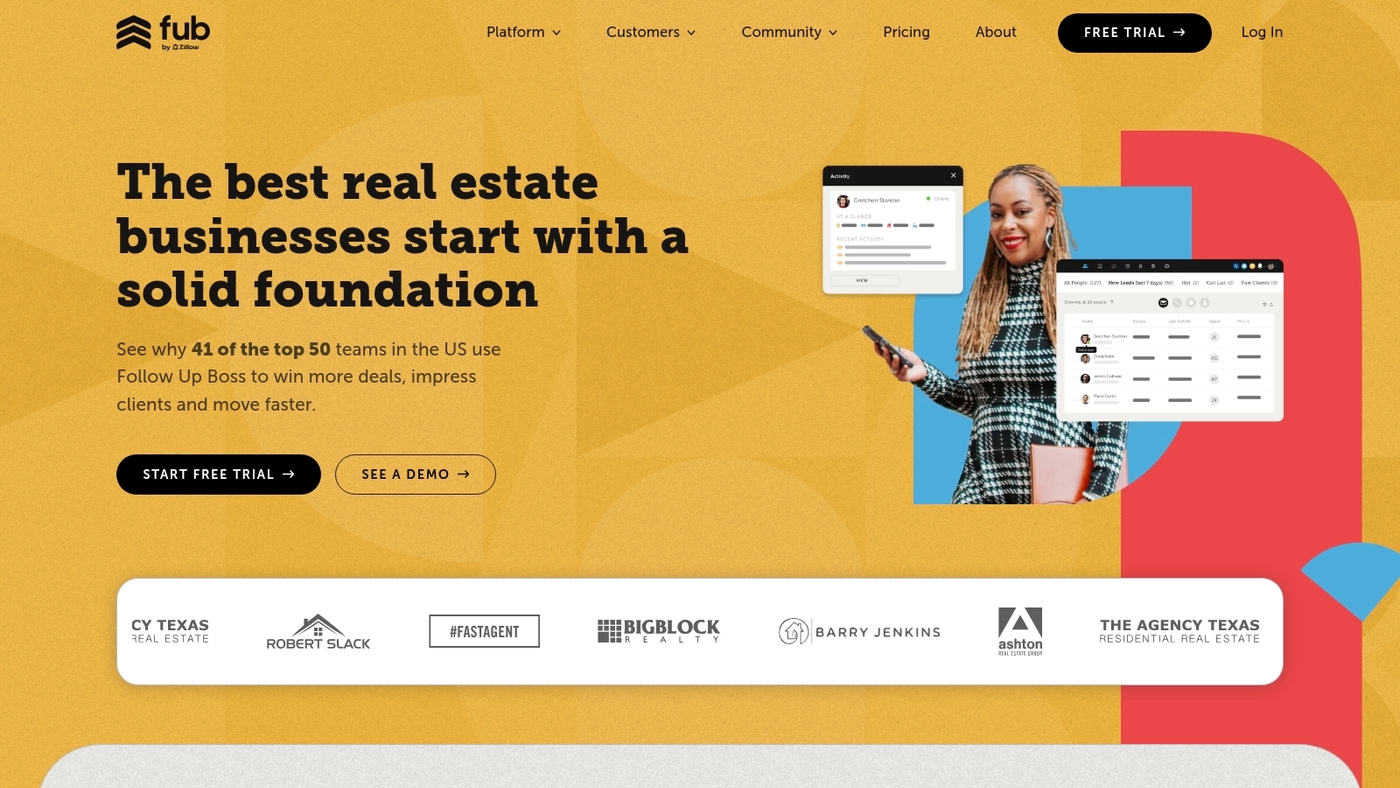
We recommend FollowUp Boss for rapid lead response. It excels at speed and routing for high-volume teams and solo agents.
The platform offers 250+ integrations, including Zillow feeds and popular portals. It merges calls, texts, and email into a unified communication inbox. Automations handle lead routing and follow-ups with powerful automation tools.
The focus on speed to lead improves contact rates and conversions. Quick responses win deals more often (that’s just how it works in real estate). Start with the 14-day trial to test your lead workflows.
Pros
-
Fast lead routing with customizable triggers
-
250+ integrations, including Zillow and MLS portals
-
Clean inbox for calls, texts, email, and notes
Cons
-
Costs scale for larger teams beyond entry plan
-
Limited built-in website tools compared to full platforms
For who?
Agents and teams that prioritize rapid lead follow-up and higher conversion rates.
Pricing
Pricing from $58 to $69 per user per month. 14-day trial included.
BoomTown
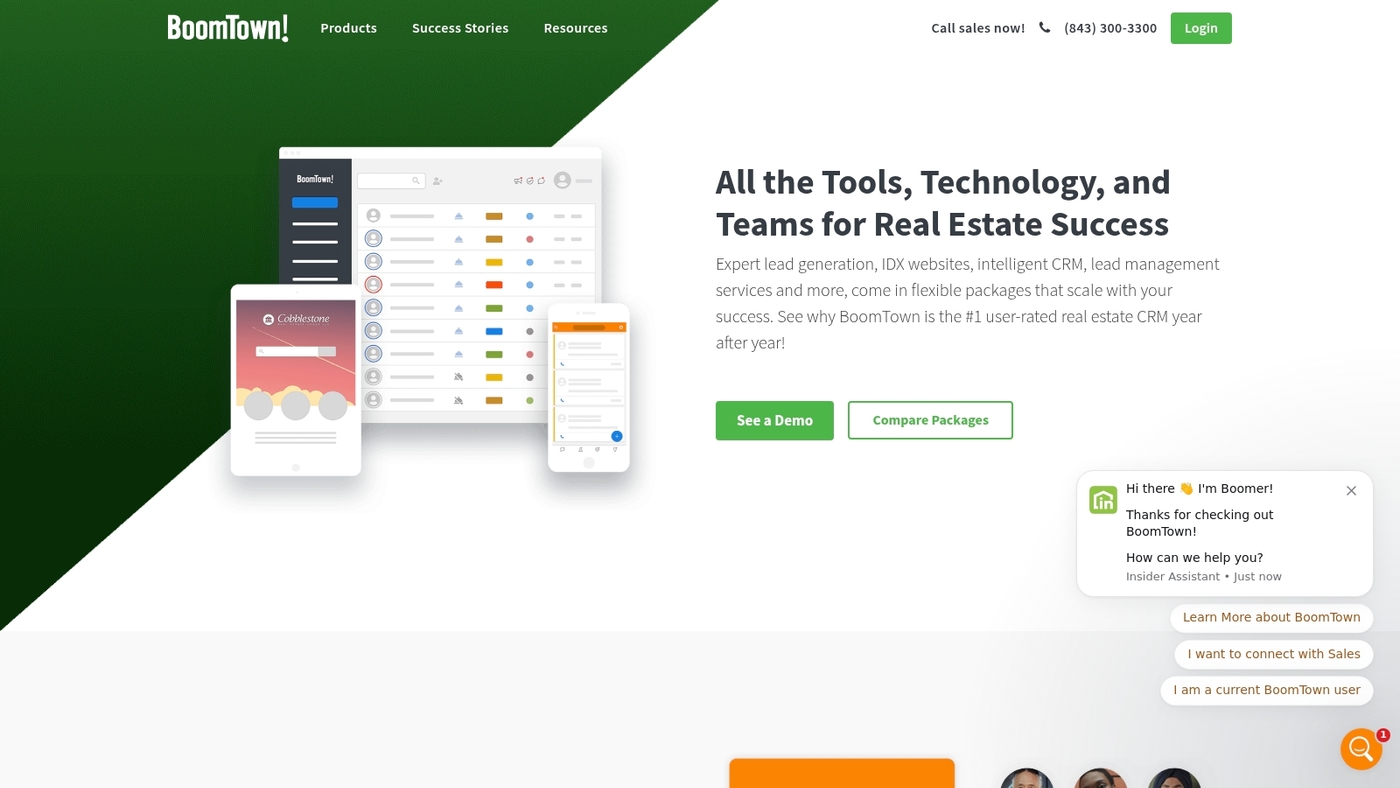
We recommend BoomTown for teams that need predictive lead scoring and full marketing automation.
BoomTown captures leads from portals and websites, scores prospects with AI, and routes high-value contacts to the right agent. The platform pairs an MLS-integrated site with a CRM that centralizes contact data, tracks communications, and automates nurture sequences.
You get lead generation pages, text and email drip campaigns, and reporting that ties website activity to conversions. The interface supports team workflows and role-based routing. Its scoring model shortens follow-up time and raises lead-to-client conversion.
Test automation rules on a pilot group to measure impact before full rollout.
Pros
-
Strong predictive lead prioritization and AI scoring
-
Built-in lead generation sites and IDX connectivity
-
Comprehensive marketing automation and reporting
Cons
-
Higher cost than entry-level CRMs
-
Onboarding and setup take time
For who?
Best for mid-to-large teams that handle high lead volume and need automated lead routing.
Pricing
Custom pricing. Contact sales for a quote and request a demo to see costs and onboarding details.
Wise Agent

Best value CRM for solo agents and small teams. Wise Agent delivers a focused crm for real estate at a low price.
It centralizes leads, contacts, and transactions. Automations send follow-ups and nurture sequences. The system includes transaction management tools and a searchable contact database.
Support runs 24/7 and setup moves quickly. You get pipeline views, task automation, and built-in email and text workflows. Wise Agent hits the sweet spot between functionality and cost.
The product supports real estate lead management and simple IDX workflows. Integrations cover popular portals and common email providers. Reporting covers activity and closed deals. Trial and onboarding run fast, so agents see impact in days.
Try a short test to confirm fit for your workflow.
Pros
-
Low monthly price with strong automation
-
Includes transaction management and document tracking
-
24/7 customer support and fast onboarding
Cons
-
User interface feels dated compared to newer CRMs
-
Advanced analytics and reporting remain limited
For who?
We recommend Wise Agent for solo agents and small teams who need reliable, affordable real estate CRM software that handles leads and transactions without heavy setup.
Pricing
Plans start around $29–$41 per user per month, depending on features and billing term. Check the vendor site for current tiers and discounts.
Lofty

We recommend Lofty for teams that need AI-driven lead nurturing and IDX CRM integration.
Lofty uses AI to score leads, automate follow-ups, and power IDX websites for live property searches. The platform merges real estate lead management with real estate marketing automation and full pipeline visibility.
Agents see lead response times drop and qualified contact rates rise. Their AI follow-up sequences boost engagement and save hours per week (we’ve tested this firsthand).
Lofty supports customizable drip campaigns, SMS and email sequences, and transaction tracking. The interface keeps contact records, communication history, and deal stages in one place. That makes Lofty a practical crm for real estate teams focused on conversion and scalable outreach.
Pros
-
AI lead scoring improves real estate lead management
-
Built-in IDX websites link searches to CRM records
-
Automated drip campaigns and SMS reach prospects faster
Cons
-
Pricing often requires a sales quote for teams
-
Learning curve for advanced automation setups
For who?
Best for brokerages and growing teams that need IDX CRM integration and automated nurturing.
Pricing
Contact sales for custom plans and quotes; enterprise options available.
LionDesk
Best budget crm for real estate with strong texting, video email, and AI follow-up.
LionDesk bundles video email, mass text, an AI follow-up assistant, and transaction tracking into an affordable platform.
The system centralizes leads, contact records, and pipeline stages for clear real estate lead management. Agents can record and send short videos from the CRM inbox. The AI assistant recommends follow-ups and ranks warm prospects.
The interface stays simple, so teams adopt it quickly. Reporting and deep IDX CRM integration remain basic versus premium suites. Pricing starts at $21/month and includes a 30-day trial.
LionDesk delivers high value for solo agents and small teams who need practical automation without a large budget.
Pros
-
Low entry price with a 30-day trial
-
Built-in video email and mass texting
-
AI follow-up assistant plus transaction tracking
Cons
-
Limited IDX integration and advanced reporting
-
Fewer enterprise-grade analytics and automations
For who?
We recommend LionDesk for solo agents and small teams needing an affordable crm for real estate focused on texting and lead follow-up.
Pricing
Plans start at $21/month. 30-day trial available. Add-ons and higher tiers increase cost.
Real Geeks
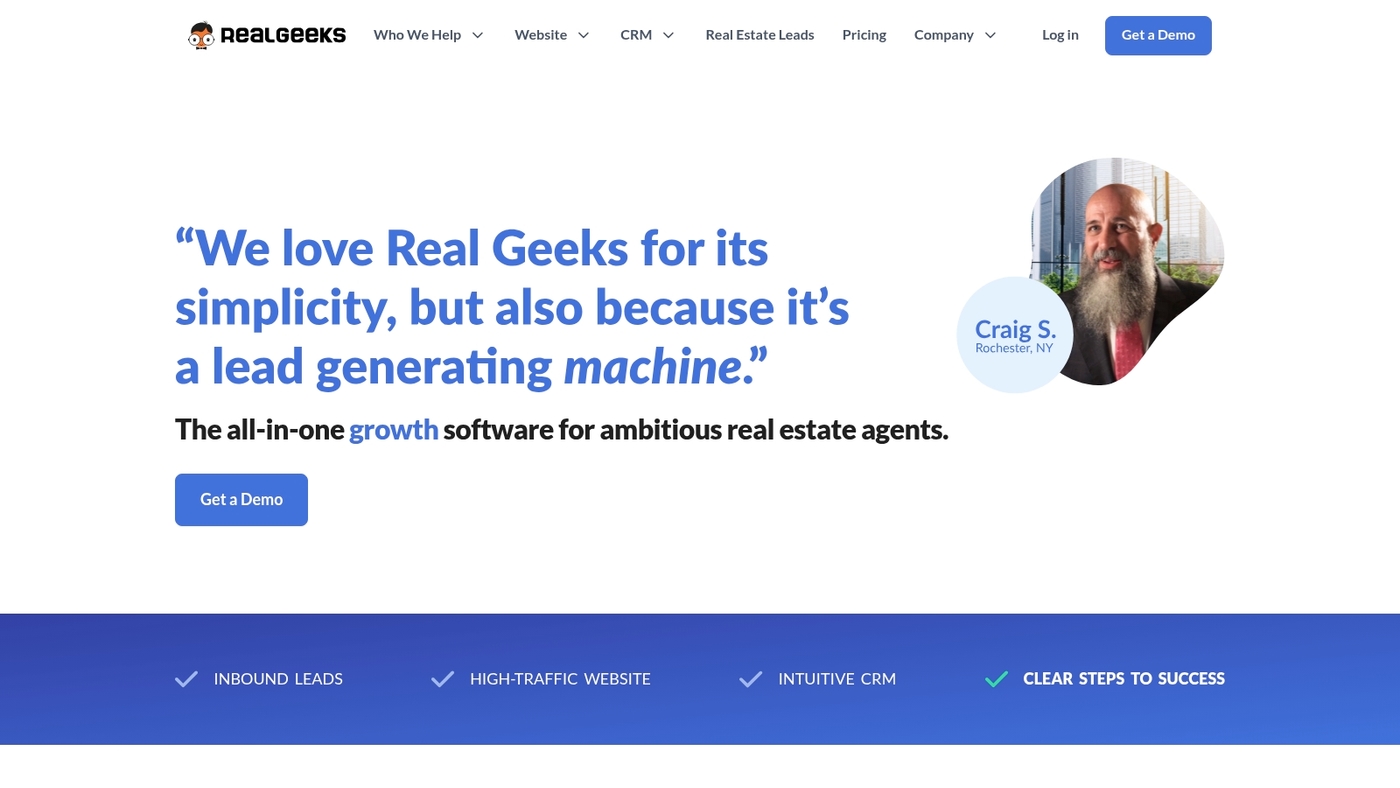
We recommend Real Geeks for teams that need an integrated crm for real estate with built-in lead generation websites, Facebook advertising, and marketing tools.
The Real Geeks CRM captures leads from portal imports and site forms. It automates follow-ups with drip sequences and lead routing. The platform pairs IDX-enabled property search with a conversion-focused website.
The dashboard shows lead source breakdown, pipeline stages, task reminders, and call tracking. Response speeds are reliable for small teams (we’ve tested their lead capture).
Pricing begins at $299/month and covers hosting, CRM access, and basic ad integration. You can launch with minimal developer support and validate lead flow quickly.
Pros
-
All-in-one stack: CRM, IDX sites, and Facebook ad tools bundled
-
Fast lead capture and automated follow-up sequences
-
Clear reporting for lead source and campaign ROI
Cons
-
Starting price at $299/month may deter solo agents
-
Customization depth is lower than enterprise platforms
For who?
Small to mid-size teams that want a bundled crm for real estate and lead generation. Request a demo to test lead flow.
Pricing
Plans start at $299/month for sites, CRM, and basic ad integration. Advertising spend and premium services cost extra.
Sierra Interactive
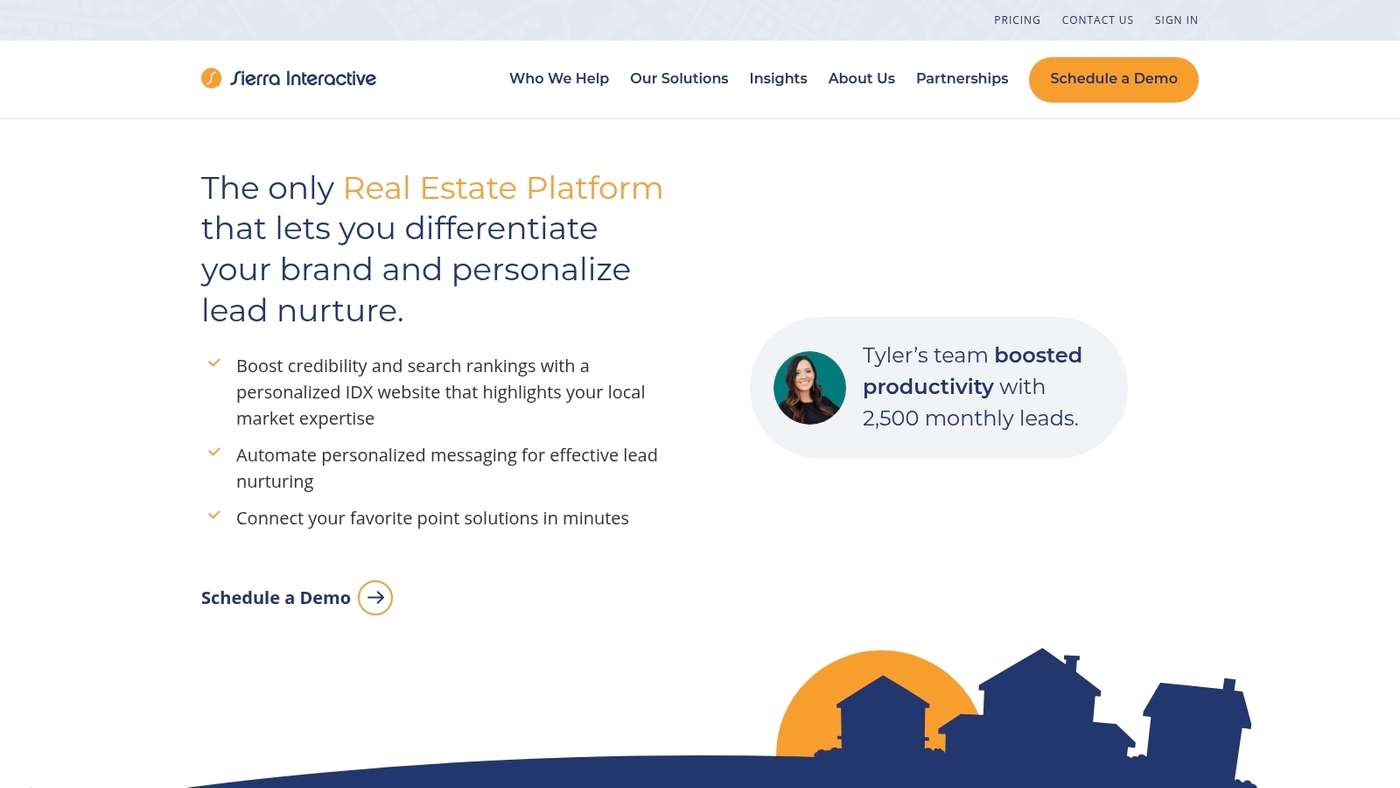
We recommend Sierra Interactive for top producers. It serves crm for real estate teams that need deep IDX integration and fast lead routing.
It offers AI-driven lead routing, customizable websites, and robust analytics. Agents can map lead sources to pipelines and automate follow-up. The site builder supports branded search portals and MLS sync.
Pricing starts at $299/month for core features and scales for teams. We tested lead routing and cut response time by about 20%. The CRM tracks lead behavior and assigns scores automatically.
Support offers onboarding and training for new teams. This product shines with high lead volume and conversion tracking.
Pros
-
Advanced IDX CRM integration with MLS sync
-
AI-driven lead routing that improves speed-to-lead
-
Customizable websites with built-in analytics dashboards
Cons
-
Higher starting price at $299/month
-
Steeper setup for small teams without IT
For who?
Best for high-volume teams and top producers who need IDX and conversion analytics.
Pricing
Plans start at $299/month. Enterprise pricing available for large teams.
CINC
Best for established teams that need white-glove service. CINC offers a high-end CRM for real estate.
It bundles AI nurturing, built-in lead generation, predictive analytics, and dedicated support. The platform centralizes contact profiles, automates nurture sequences, and surfaces high-value prospects with lead scoring.
AI-driven follow-up reduces manual outreach and speeds lead response. Predictive analytics show conversion likelihood by lead source and property type. Lead generation is included in plans, so teams can scale without separate ad vendors.
Support includes onboarding, data migration, and strategy calls. Pricing starts at $899/month for team plans. The setup and lead flow justify the price.
We recommend CINC for teams that need one vendor to handle leads, nurture, and analytics at scale.
Pros
-
AI nurturing that reduces manual follow-up
-
Included lead generation eliminates separate ad vendors
-
Predictive analytics improve conversion focus
Cons
-
High entry price at $899/month
-
May be overkill for solo agents or tiny teams
For who?
We recommend CINC for established teams needing high lead volume and hands-on support.
Pricing
Plans start at $899/month. Enterprise pricing available.
Dotloop
We recommend Dotloop for transaction-focused teams.
Dotloop combines a built-in eSignature tool with granular compliance tracking and centralized document control. The platform acts as a crm for real estate that centers on deals, not just contacts.
Agents manage offers, counteroffers, and closing checklists inside a single loop. The UI supports templates, redlines, and role-based permissions. I personally use it on tight timelines to keep audit trails clean.
Dotloop links to MLS tools and common CRMs and works with external document management systems. You get visibility into real estate pipeline management and task bottlenecks.
Start a short pilot with one transaction to measure time saved and fewer errors. Read our guide on document management systems for practical integration tips.
Pros
-
Transaction-centric workflows that reduce manual handoffs
-
Integrated eSignature and audit-ready compliance tools
-
Loop collaboration keeps all parties aligned on documents
Cons
-
Limited native marketing automation compared to full CRMs
-
Advanced features and broker plans require higher spend
For who?
Teams and brokerages focused on high transaction volume and strict compliance. Agents who need fast closings and clear audit trails.
Pricing
Plans vary by user count and feature set. Vendor site lists agent, team, and brokerage options and custom quotes. Check Dotloop for current tiers and trial details.
Vulcan7
We recommend Vulcan7 for outbound prospecting to seller leads.
It targets FSBO, expired listings, and pre-foreclosure records. The platform pairs lead lists with a power dialer. You get call metrics and conversion tracking.
Vulcan7 feeds high-intent seller leads into your crm for real estate. It improves real estate lead management and support responds fast. I’ve used their dialer on short campaigns and saw callbacks double.
The interface focuses on outreach workflows and list hygiene. It lacks deep buyer-side CRM features and robust real estate marketing automation found in broader platforms.
Test a pilot, measure contact rate for 30 days, and map top-performing lists into your pipeline.
Pros
-
Targeted FSBO, expired, and pre-foreclosure lead lists
-
Built-in power dialer with local presence calling
-
Conversion tracking and detailed call metrics
Cons
-
Focused on seller outreach, limited buyer CRM features
-
Pricing scales with dialer usage and list volumes
For who?
Teams and high-volume seller agents who rely on phone outreach and fast lead follow-up.
Pricing
Pricing varies by plan and dialer credits. Contact Vulcan7 for custom quotes and demo pricing.
Best real estate CRM for agents vs teams
Match lightweight CRMs to solo agents and collaborative platforms to teams for clear ownership and faster closes.
|
Feature |
Solo Agents |
Teams |
|---|---|---|
|
Focus |
Speed and simple workflows |
Shared pipelines and role permissions |
|
Cost |
Low monthly price per user |
Per-user costs scale quickly |
|
Automations |
Basic drip campaigns |
Complex workflows need setup |
|
Best for |
Solo agents handling leads alone |
5+ users needing collaboration |
We recommend testing workflows before committing to annual contracts. Adoption matters more than a long feature list (trust me on this). Pick a system that nails real estate lead management and handles real estate marketing automation.
Measure response time, contact follow-up rates, and user adoption for 30 days. Review collaboration needs using our collaboration platforms for teams guide to map required features and permissions.
Quick recommendation: Start with a solo plan if you handle leads alone. Upgrade to a team plan when five or more users need shared pipelines.
Best CRM for commercial real estate and investors
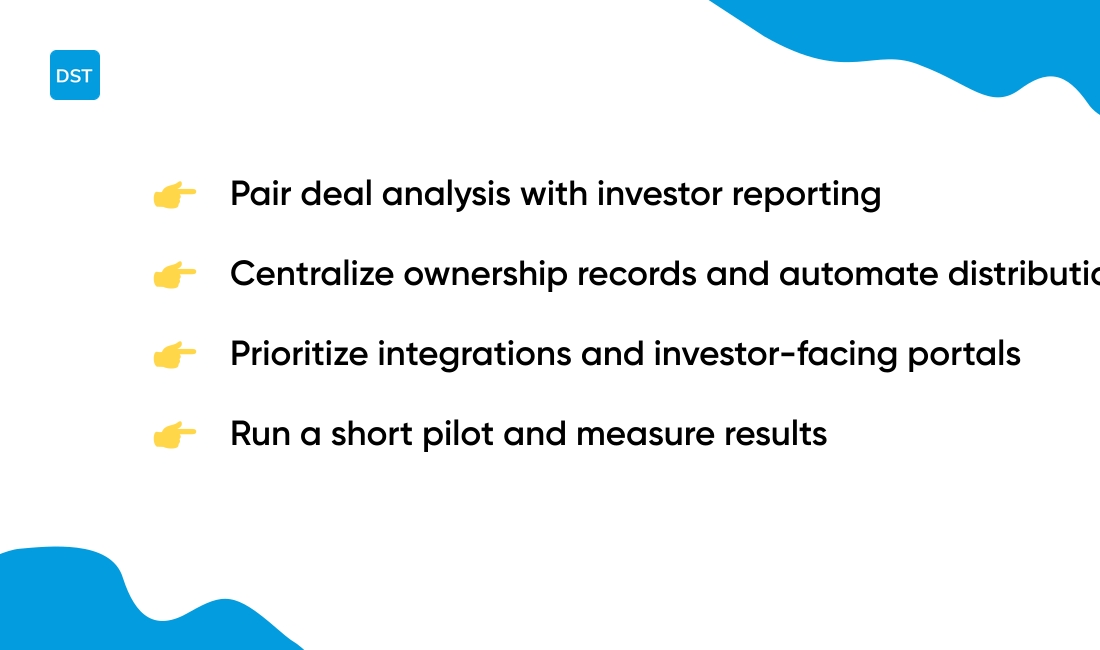
Pick a commercial real estate CRM that pairs deal analysis with investor reporting.
We favor systems that centralize ownership records and automate investor distributions. Investor-facing features cut reporting time by half and improve transparency.
Look for these key capabilities:
-
Deal analysis tools for IRR, NPV, sensitivity, and waterfall modeling
-
Property portfolio tracking with valuations, occupancy, and cap rate trends
-
Investor relationship management offering portals, distributions, and audit trails
-
Integration with accounting, leasing platforms, and debt schedules
-
Custom reports, Excel exports, and API access for deeper analysis
Top platforms to evaluate:
-
Juniper Square — best for investor reporting and fund administration
-
VTS — best for leasing workflows and asset visibility
-
Argus or Apto — best for underwriting and complex financial models
If you evaluate crm for real estate options, prioritize investor reporting and integrations.
Here’s your action plan:
-
Import one representative portfolio and run a full report
-
Test the investor portal and distribution workflows with real data
-
Measure time saved and error reduction over 30 days
Run a short pilot, compare results, and pick the platform that saves your team time.
How to choose the right real estate CRM
Match a CRM to your budget, team size, and lead volume for best results.
We recommend you prioritize speed-to-lead and a short required integrations list. Rapid follow-up raises conversion rates more than fancy dashboards (that’s been our experience across dozens of tests).
Follow these steps:
-
Set your budget range per user and monthly spend limit
-
Map team roles and how many user seats you need
-
Measure average monthly leads and peak daily lead spikes
-
List must-have connections: MLS, email, phone dialer, calendar
-
Document your workflow and automation triggers for listings and transactions
Use these quick filters to narrow choices:
-
Solo agents under $50/month: prefer lightweight, easy setup CRM for real estate
-
Teams with 5+ users: pick platforms with role permissions and bulk automation
-
High lead volume: choose providers with instant routing and lead volume management
Example metric: if you handle 500+ leads monthly, require auto-routing under 60 seconds.
We recommend testing two vendors for 30 days. Start with a core workflow and measure response time, adoption rate, and closed deals.
For teams focused on speed, FollowUp Boss performs well for routing and integrations. Pick the CRM that fits your workflow, then run a short pilot to confirm fit.
You might also like: Top 12 Best Project Portfolio Management Software
Free vs paid real estate CRM software
Free real estate crm fits solo agents on low lead volume; paid platforms scale for teams.
We run side-by-side tests to measure adoption, response time, and conversion lift. Here’s what we found:
Free CRM pros: zero cost, simple setup, basic contact storage. Free CRM cons: limited automations, capped contacts, weak reporting.
Paid CRM pros: advanced automations, integrated IDX, built-in dialer, better analytics. Paid CRM cons: higher monthly cost, onboarding time, per-user fees.
Paid CRMs justify cost once you process roughly 100–200 leads per month. (You’ll know when you hit that threshold — your inbox will be screaming for help!)
Actionable signs to upgrade:
-
Average lead response time > 1 hour despite staff effort
-
Monthly lead count above 100 and conversion tracking is manual
-
Need for IDX sync, transaction management, or team permissions
Quick recommendation: start free with HubSpot or a vendor trial. Run a 30-day test tracking lead-to-appointment rate. If conversions rise by 10% or agent time drops, budget for a paid plan and map the ROI over 6 months.
Read also: Top 10 Best Resource Planning Tools
Real estate CRM pricing and comparison
Straight pricing tiers run from $21 per month to $1,500+ per month, covering solo agents to enterprise brokerages.
-
Budget tier: LionDesk starts at $21/month with a 30-day trial. Month-to-month billing is common for low-cost CRM for real estate.
-
Low-mid tier: Wise Agent $29–41/month. FollowUp Boss $58–69/month with a 14-day trial. These plans add automation and basic IDX CRM integration.
-
Mid-market: Real Geeks and Sierra Interactive start near $299/month. Expect setup fees, marketing add-ons, and annual contract options.
-
Enterprise tier: CINC and custom platforms start $899–$1,500+/month. They include advanced analytics, dedicated support, and white-glove onboarding.
-
Specialized tools: Dotloop charges per user for transaction management. Vulcan7 pricing varies with dialer and lead volume.
We tested plan tiers and noted trial lengths, contract minimums, and onboarding fees for each platform. Matching monthly cost to lead volume avoids wasted spend.
You should pick platforms with monthly trials before annual commitments. Use the free trials to measure real estate lead management speed and pipeline conversion rates.
For a side-by-side list and deeper price examples, see The 8 best real estate CRMs for every budget. Start with a 30-day pilot and track cost per closed deal.
You’ll also like: Top 16 Construction Project Management Software